Russia
Doctor ZhivagoRussia in these episodes is at once a country undergoing upheaval and a force that reshapes private lives. Revolution, railway strikes, military defeat, and mass mobilization enter domestic and professional worlds; later, the landscape becomes the object of a character’s expansive declaration of love for life. The novel’s Russia is therefore neither a mere backdrop nor a single political idea: it is a place where historical violence unsettles everyday existence, and where life’s irrepressible continuity remains imaginable.
A Country in Upheaval
The narrative first places Russia amid overlapping conflicts. The war with Japan has not ended when successive revolutionary waves begin to eclipse it. Against this unsettled background, Amalia Karlovna Guishar arrives in Moscow from the Urals with Rodion and Larisa, enrolling her children in school and taking over a dressmaking business. The movement from the Urals to Moscow is personal and practical, but it also places a family’s attempt to establish itself within a country whose political order is already in motion.
The railway network makes that instability visible as collective action. In autumn, workers on the Moscow-Kazan line strike, while a strike on the Moscow-Brest Railway is expected. The decision has been made, but the committee is still disputing the date; everyone knows that only a pretext is needed. On payday, workers cross the station grounds between the management buildings and the platforms, workshops, warehouses, and engine sheds. The ordinary circulation of wages and railway labor becomes the setting for a conflict whose arrival is anticipated before it begins.
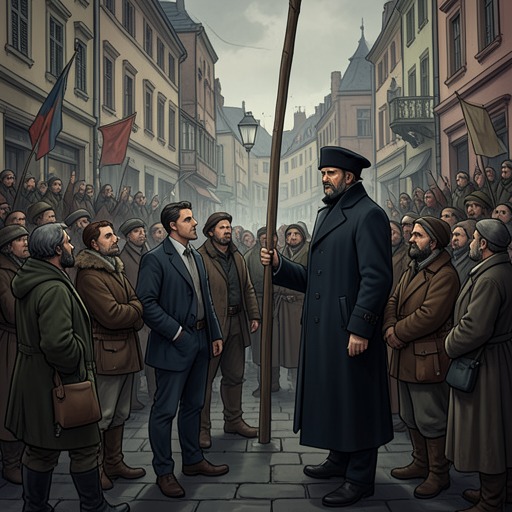
After the October Manifesto, revolutionary organizations call for a demonstration from the Tver Gate to the Kaluga Gate. Their planners quarrel and withdraw one by one; when they learn that crowds have gathered anyway, they hastily send representatives to lead them. Kuprian Savelievich Tiverzin tries to dissuade his mother, but she joins the march, accompanied by Pasha Antipov. The episode presents political mobilization as both organized and improvised: leaders falter, while ordinary people proceed into the streets.
War and the Disruption of Daily Life
Later episodes show Russia’s wartime crisis through the movement of wounded people and retreating institutions. When a truck and two trailers reach a hospital entrance, wounded men are carried inside. Moscow hospitals are already desperately overcrowded, especially after the battle of Lutsk; patients occupy passages and landings, and the pressure is beginning to reach the women’s wards. The war thus changes not only the front but the capacity of civilian medical spaces to function.
At the front, an advance cuts through enemy positions, but supporting units fall behind, leaving the leading troops isolated and captured. Lieutenant Antipov is among the prisoners after his platoon surrenders. Galiullin, who watched the attack from an observation post, mistakenly believes Antipov has been killed when shells obscure the field. The account’s shift from the advancing unit to the observers’ uncertainty makes the battlefield a place where information, as well as lives, is endangered: Antipov’s capture is real, but the report of his death is false.
The medical station receives another measure of the same violence. Exhausted survivors of a unit decimated in four days of fighting lie beside the road, too spent to respond as carts bring in wounded men picked up shortly before during a lull in the shelling. The carts jolt their passengers on the way to hurried bandaging and emergency operations; about half the wounded are unconscious. The scene links the duration of combat to the immediate limits of care, showing a chain that runs from frontline attrition to improvised treatment rather than presenting battle as an isolated encounter.
The front’s movement finally reaches the village where Yurii Andreievich Zhivago and Misha Gordon are staying. Shouts, gunfire, and running footsteps wake them at night; Zhivago learns that the Germans have broken through and finds the village under fire. The hospital begins moving at once, without waiting for an evacuation order. He arranges for Gordon to leave in the first party and promises to see him off. Flight here is not an abstract consequence of war: it is a hurried, organized response in which a doctor must help move people even as the surrounding settlement becomes unsafe.
Mobilization and Social Reordering
The railway also carries a different kind of wartime burden. A train of twenty-three cars has sailors at the front, civilian passengers in the middle, and labor conscripts in eight cars at the rear. There are about five hundred conscripts, drawn from sharply different ages, occupations, and social positions. Lawyers and stockbrokers travel alongside cab drivers, floor polishers, bath attendants, Tatar ragpickers, people described as escaped lunatics, shopkeepers, and monks, all grouped under the political label of the exploiting classes.
Their circumstances within the same train are unequal. Lawyers and stockbrokers sit around hot iron stoves, exchange stories, and joke; they are confident that influential relatives can intervene and that, if necessary, money can secure their release. The contrast makes the train a moving cross-section of a society being reorganized by compulsion. The policy gathers people who have little in common, but their different resources shape how exposed each group is to its consequences.
Russia as a Living Presence
In a later spring scene, Zhivago’s inward attention opens outward from the sounds of children playing in the streets to Russia as a whole. He imagines the country as incomparable, celebrated and suffering, stubborn, extravagant, unpredictable, and beloved. This is not a detached description of a political territory: the country’s contradictions are gathered into an intimate affirmation of being alive and of wanting to thank existence.
The passage also connects that vision of Russia to Lara. Zhivago understands her as a representative and expression of life itself: through her, an otherwise inarticulate principle becomes sensitive and capable of speech. His thought reverses the doubts he has just entertained about his own love. Russia and Lara are not made equivalent in a literal sense; rather, the scene places his personal attachment within a larger apprehension of life that extends beyond individual speech or intention.
War, Home, and the Meaning of History
Lara offers a contrasting account of why ordinary life has broken apart. She recalls that she and Pavel Pavlovich Antipov married two years before the war and had only begun establishing a home when it began. In her explanation, the war is responsible for the later misfortunes that continue to pursue their generation. She contrasts the former expectation that people would follow reason and conscience, and that murder was exceptional, with the subsequent normalization of mass violence.
Her account extends beyond combat to the breakdown of the conditions that sustain a household. Trains and urban food supplies fail; family foundations and moral standards erode along with them. What remains, she says, is the exposed human soul reaching toward another similarly lonely person. The image of people made naked and homeless at the end of a long history links private separation to the ruin of a shared way of life. In this account, Russia’s upheaval is not only a sequence of political events: it strips away customs and institutions that had made home seem durable.
A different historical scale appears in an account of revolution that sets Lenin amid a longer inheritance of political thought and struggle, from European revolutions and Russian exile to labor movements and Marxism. Russia then rises in the speaker’s vision as a vast figure bursting into flames, carrying the promise of redemption for human suffering. The image is an impassioned interpretation, not a description of a settled outcome. Read beside the strikes, overcrowded hospitals, forced labor, and flight from a village under fire, it preserves the distance between revolutionary hope and the human costs visible elsewhere in the narrative.
Together these episodes make Russia a setting of both involuntary movement and emotional attachment: families arrive, workers mobilize, troops advance and are captured, patients are carried into crowded hospitals, conscripts are transported, and civilians flee. Yet the country is also apprehended as a living whole, capable of inspiring gratitude and love. Its significance lies in that unresolved conjunction: history repeatedly dismantles the arrangements of ordinary life, while the characters’ attachment to life and to one another remains a counterforce to the devastation.